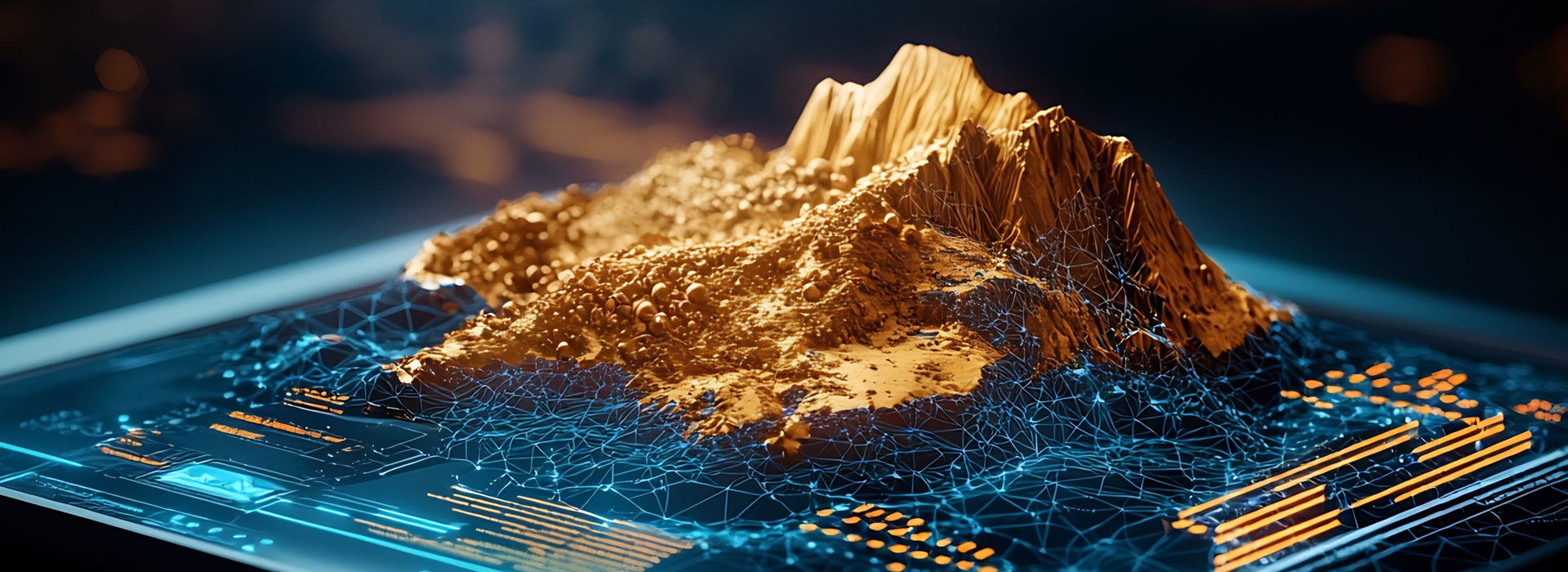
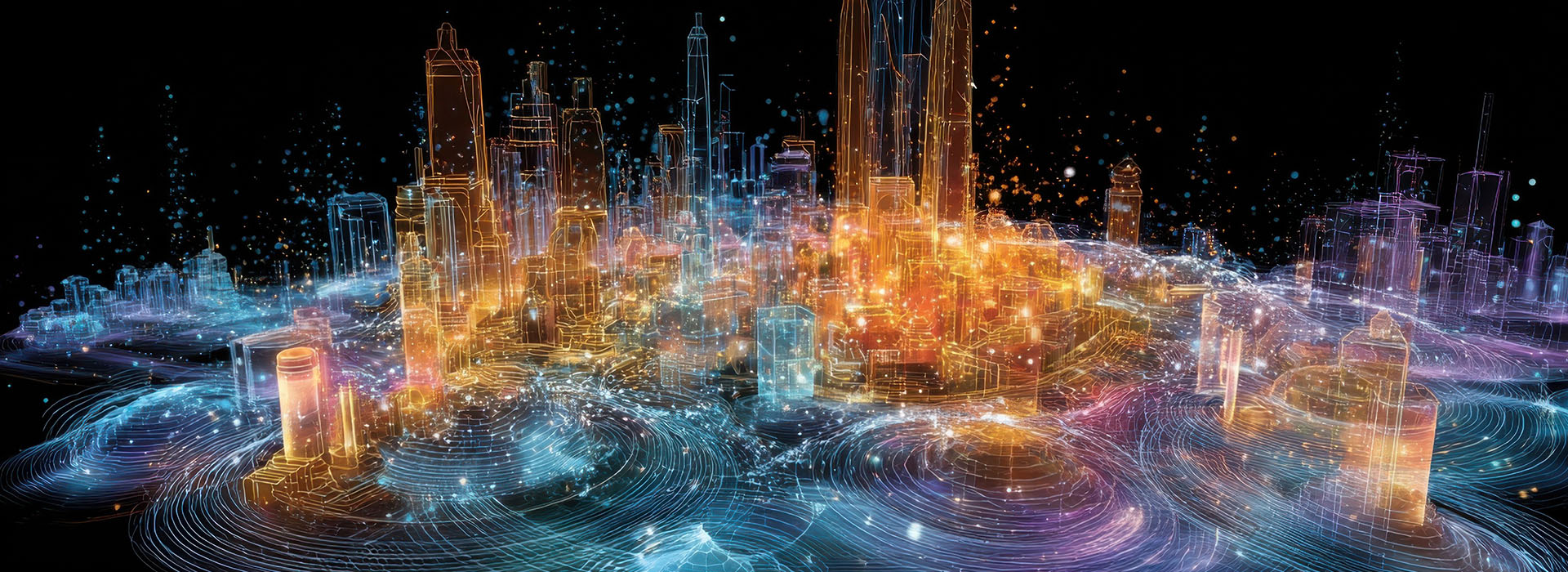
For decades, industries have relied on 2D maps and 3D surface models to understand the world.
These tools helped us build cities, design mines, and plan infrastructure. But they all suffer from the same fatal flaw: They only show the surface.
Everything beneath, the geology, utilities, voids, density transitions, moisture pockets, structural weaknesses, is hidden. In other words: Surface models reveal the outline of reality, but not its substance. And today, that limitation is costing organizations millions.
Surface Models: The Illusion of Understanding
Surface models were built for an era when shallow data was enough. But modern projects are deeper, denser, and far more data rich. A typical surface-based workflow struggles with:
- Hidden geology and subsurface structure
You see a slope but not the weak layers inside it. You see a tunnel route but not the fractures it intersects. - Sparse data interpolation
Drill holes are spaced far apart, so everything in between becomes a guess. - No material properties
A mesh can’t store density, moisture, porosity, grade, or contaminants. - No depth-based analysis
You can’t simulate flows, stresses, deformation, or excavation changes inside a surface. - No time dimension
A 3D model is just a snapshot, not a living, evolving representation. It’s like looking at the wrapping paper and trying to understand the gift inside.
Volumetric Intelligence: Seeing Inside the World
To break past the limits of surfaces, we must model the world as it truly exists:
As a volume. Layered. Dense. Dynamic. Rich with properties and structures throughout its interior.
This is the foundation of Volumetric Spatial Intelligence (VSI), the engine behind Voxel Space.
Instead of lines, meshes, or surfaces, Voxel Space represents reality as a continuous grid of voxels:
Each voxel is a tiny 3D cube that stores real-world data:
- Density
- Moisture
- Porosity
- Rock type
- Ore grade
- Contamination
- Utility type
- Stress or strain
- Flow rate
- Sensor feeds
- And much more
You don’t just see the outside of your world, you see what’s inside it.
Why “Volumetric” Matters More Than Ever
Modern environments demand deeper understanding:
- Mining
Ore bodies are complex, folded, faulted, and highly variable. Surface-only models hide billions of dollars in uncertainty. - Cities & Infrastructure
Before you design a tunnel, pipeline, or subway, you must know exactly what lies beneath. - Energy & Environment
Groundwater doesn’t move on the surface. Contamination doesn’t spread in 2D. Weather impacts aren’t flat. - Security & Defense
Sensor fusion, underground infrastructure, and risk detection all rely on depth-aware intelligence.
In every sector, the surface model is becoming a liability. Volumetric intelligence is becoming the new standard.
Why Voxel Space Leads the Volumetric Revolution
Voxel Space is the first platform designed from the ground up for full volumetric Digital Twins, not surface approximations.
It delivers four major breakthroughs:
- Spatial Intelligence in 4D Volumes
Model interior geology, utilities, and material properties, and track how they change over time. - High-Resolution Visualization Anywhere
Stream massive volumetric Digital Twins, even on mobile devices, with workstation-level clarity. - Massive-Scale Computation at Breakthrough Speed
Compute trillions of voxels using cloud-parallel processing. Simulate, analyze, and classify at volumes other systems can’t handle. - Extreme Precision & Data Accuracy
From city-scale to sub-micrometer detail, Voxel Space preserves the fidelity modern decisions require.
Surface Models Belong to the Past. Volumetric Intelligence Is the Future.
The world isn’t made of surfaces. Your models shouldn’t be either. If your decisions depend on what’s inside the ground, or inside your data, it’s time to move beyond surface limitations and adopt true volumetric intelligence.